Followers

Friday, May 30, 2025

P. O. Spa

 The Post Office Spa, better known as the P.O. Spa, opened for business at 690 Dwight Street on October 29, 1936. The luncheonette was situated in the Urania Block at the southwest corner of Dwight and Elm Streets. Its immediate proximity to the U.S. Post Office likely contributed to the origin of its name.

The restaurant was opened by Ferdinand "Fred" Rigali, who lived at Sonoma Place, a stone's throw from the restaurant location. For years, he maintained a 5 A.M. opening time for breakfast and lunch service. His specialty was Italian-American dishes.

Mr. Rigali had a background in the restaurant industry, having managed the Chateau Harmonty in Granby, Mass, in the 1930s. He was an employee of his brother, Peter, at his restaurant during the 1930s. Additionally, in the late 1920s, he co-owned the Lincoln Spa, another popular establishment of its time. This was situated at 94 Suffolk Street, at the southwest corner of Chestnut.

In 1950, after Peter Rigali's death, Mr. Rigali purchased Peter's, which was located in the Knights of Columbus (K of C) building opposite the Victory Theater at 84 Suffolk Street. He would manage that restaurant while his wife, Leonetta, managed the P.O. Spa. Peter's Restaurant was sold in February 1956.

In 1952, Mr. Rigali, an active K of C and Elks member, opened a six-lane bowling alley in the K of C building. He sponsored the P.O. Spa team in the bowling league. He was also an avid bowler and had competed in a national candlepin championship in Boston in 1952.

The P.O. Spa was one of the very popular morning and lunchtime spots with students at Holyoke Catholic High School. The restaurant was involved with the school through its participation in fundraisers and the sale of tickets to various events.

The P.O. Spa continued to operate in the Rigali family for 37 years. In 1973, the business was sold to Caroline Orsini, with whom he had been a business partner when they owned the Lincoln Spa. In March 1977, the P.O. Spa was sold to Shirley Zebrowski, and it was later sold to Constance and Roland Roy that same year. 

Although an exact year was not discovered, the P. O. Spa closed during the late 1980s or very early 1990s.

Citations:

Newspapers.com (paid subscription): Citations: Holyoke (Massachusetts) Transcript & Transcript-Telegram; Springfield (Massachusetts) Republican); Orlando (Florida) Sentinel; publication dates and pages are shown.

MACRIS: Massachusetts Cultural Resource Information System  Search Results - MACRIS

Google Maps; maps.google.com

Facebook: Growing Up in Holyoke, Massachusetts

Ancestry: Price & Lee City Directories, Holyoke, Massachusetts

                                Photo Credit: Facebook; Growing Up in Holyoke, Massachusetts

Photo Credit: online Google Maps

City of Holyoke, Massachusetts: R/E Property Card, 690 Dwight Street


Thursday, May 29, 2025

Winfield Hat Company

 Many of the businesses identified throughout this blog have ceased operating. This is a story about a company that closed down twice during its existence: the Winfield Hat Company.

The business was founded by Ben Freeman, who was employed by Bay State Hat Co. in Holyoke, and Arthur Schoer, an Army Air Force veteran. Mr. Freeman was the plant foreman and designer. Also designing was Florence Quinn, who would visit Holyoke to sketch her latest ideas from the fashion world. Mr. Schoer handled the business matters

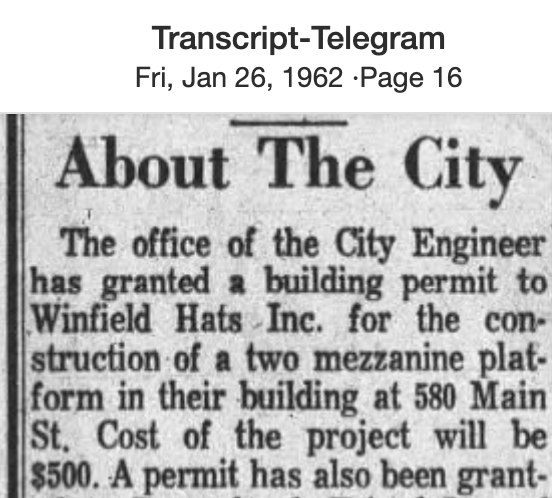
The Winfield Hat Company began in early 1946 on the second floor of the former American Thread Co. factory at 580 Main Street. The company had 13,000 square feet of space in the building built in the late 1890s and owned by Charles Belsky. The company's sales office was in New York City.

The business began with 11 employees and, within five months, had grown to 26, producing 75 dozen hats daily. The finished products were sold through New York fashion houses to department stores and mail-order services.

Some of the materials used for the veils and braiding were imported from Italy, Czechoslovakia and Switzerland.

In 1951, a Christmas party was planned in the Valley Arena, as the company had 300 employees by its fifth year in business.

On August 22, 1956, the company opened a store within the mill to the public. The shop was called Winfield Mart. The latest hat styles were sold at discounted prices.

Many of the company's employees were members of the United Hatters, Cap and Millinery Workers of America Union. There were labor-management struggles along the way, which did lead to strike activity.

By 1957, both management and labor believed that employment could reach 400 that year. Although 11 years old at the time, Winfield Hat was thought to be the third-largest millinery company in the country. The prediction as to the number of employees was greatly exceeded, as the employment count was 550 in January 1958. 

After a five-day strike, union members agreed to accept a new two-year contract in a meeting attended by 250 workers at Kelley's Lobster House ballroom.

By April 1965, the fashion world was changing, and Winfield Hats considered closing down, as hats were not selling. The 16-year-old company had been reduced to 30 employees. A going-out-of-business sale was held with substantially discounted prices. On May 8, 1965, its doors were closed.

However, union officials continued discussions with the owners concerning the possibility of reopening a restructured business. Concessions were made regarding wage reductions, and rehiring would be based on seniority. At this time, Louis Kweller was the company president, and Karl Zuckerman was its treasurer.

Six months after going out of business, Winfield Hats reopened in November 1965. At its inception, the workforce consisted of 25 employees. The opinion was that employment would increase to 150 within 6 months. The factory store was again operating.

By 1975, Winfield Hats was one of only two hat producers in New England. Although popular through the 1950s, the desire for hats waned in the late 1960s. Several factors contributed to this, including the phenomenon surrounding Jackie Kennedy. The first lady in the 1960s did not like wearing hats, and many followed her lead. Additionally, many hairstyles were not suitable for wearing hats. The advent of women's slacks and sportswear also contributed to the decline of hats. Wigs had taken the lead in headgear at this time.

A resurgence occurred in 1978, when stores such as Bloomingdale's, Macy's, Gimbels, and Lord and Taylor placed orders. The company was already supplying Sears & Roebuck and J. C. Penney. The company continued into the late 1980s and is shown as voluntarily dissolved by the Commonwealth of Massachusetts, Secretary of State's office in 1990.


White Eagle Bakery

 Throughout the writing of these stories, several 20th-century businesses along the North High Street Historic District have been featured. ...